Supreme Court grants Republicans’ request to pause order to redraw New York congressional map

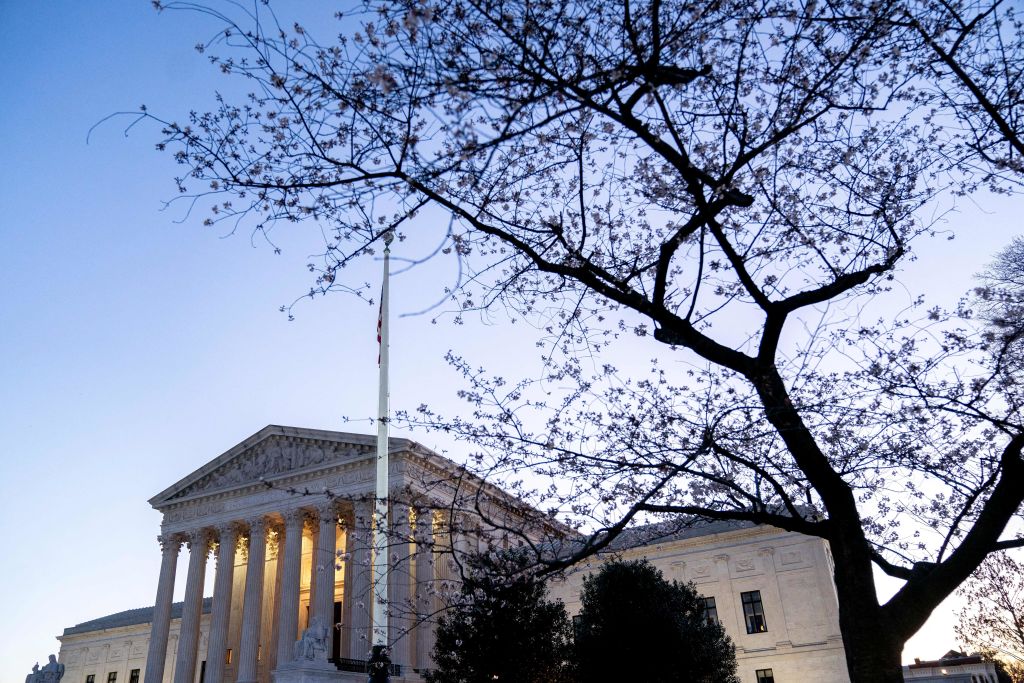
The Supreme Court on Monday night cleared the way for New York to go forward with the 2026 elections using the state’s existing congressional map. Over the objections of the court’s three Democratic appointees, the justices granted a request from a Republican member of Congress, a group of voters, and state election officials to pause an order by a state trial court that would have required the state to redraw the map to add Black and Latino voters.
Justice Samuel Alito, who penned an opinion agreeing with the decision to put the order by Justice Jeffrey Pearlman of the New York Supreme Court, which is a trial court, on hold, called Pearlman’s order “unadorned racial discrimination.”
Justice Sonia Sotomayor, who dissented from Monday’s ruling in an opinion joined by Justices Elena Kagan and Ketanji Brown Jackson, accused her colleagues in the majority of executing an “unexplained about-face” from its normal practice of staying out of cases involving state election litigation.
The case began as a challenge to the boundaries of New York’s 11th Congressional District, which includes Staten Island and parts of southern Brooklyn. A group of voters contended that the boundaries violated the New York constitution because they diluted the votes of the district’s Black and Latino residents, who make up roughly 30% of Staten Island’s population.
In late January, Pearlman ruled for the challengers. He prohibited New York from using the existing map and instructed the state’s independent redistricting commission to propose a new map by Feb. 6.
Rep. Nicole Malliotakis, the only Republican representing New York City in Congress, along with state election officials and New York voters, asked two state appeals courts to put Pearlman’s order on hold. The state’s intermediate appellate court declined to do so on Thursday, Feb. 19.
Meanwhile, the map’s defenders came to the Supreme Court, asking the justices to step in and block Pearlman’s order. In a one-paragraph, unsigned order on Monday night, the court granted that request.
Alito penned a three-page opinion elaborating on his decision to vote to pause Pearlman’s order. Pearlman, he wrote, “ordered the New York Independent Redistricting Commission to draw a new congressional district for the express purpose of ensuring that ‘minority voters’ are able to elect the candidate of their choice.” That order, he said, “blatantly discriminates on the basis of race.” Pearlman was wrong, he continued, to point to state law to justify the order, because “a state law cannot authorize the violation of federal rights.”
Moreover, Alito continued, the justices had the power to weigh in on the request to protect its ability to consider the case. Otherwise, he suggested, “there is an unacceptably strong possibility that the applicants’ appeal in the state court system will not conclude until it is too late for us to review the ultimate decision … even if it appears that the decision is based on a seriously mistaken understanding of the Constitution.”
And although the Supreme Court has made clear that courts should not change election rules too close to an election, he acknowledged, that principle seeks to avoid disruption and confusion, which is exactly what the court’s order on Monday does, according to Alito, by “eliminat[ing] much of the uncertainty and confusion that would exist if the Independent Redistricting Commission proceeded to draw a new district that this Court would likely strike down if the cases reached us in time.”
Sotomayor countered that the majority’s “101-word unexplained order can be summarized in just 7: ‘Rules for thee, but not for me.’” The Supreme Court, she said, has repeatedly “said that federal courts should not interfere with state-court litigation” or “meddle with state election laws ahead of an election.” But it nonetheless “takes the unprecedented step” in this case “of staying a state trial court’s decision in a redistricting dispute on matters of state law without giving the State’s highest court a chance to act.”
Sotomayor dismissed the warnings by the defenders of the existing map that “chaos” would ensue if Pearlman’s ruling were not put on hold quickly, calling them “illusory.” “The general election is eight months away and the primary is about four months away,” she noted. “That is more than enough time for” the map’s defenders to ask the state’s highest court to step in or even for “the New York courts to decide this case finally on the merits.”
Sotomayor cautioned that the court’s actions on Monday could have broader implications for its interim docket. “By granting these applications,” she wrote, “the Court thrusts itself into the middle of every election-law dispute around the country, even as many States redraw their congressional maps ahead of the 2026 election. It also invites parties searching for a sympathetic ear to file emergency applications directly with this Court, without even bothering to ask the state courts first.”
Posted in Court News, Emergency appeals and applications
Cases: Kosinski v. Williams